
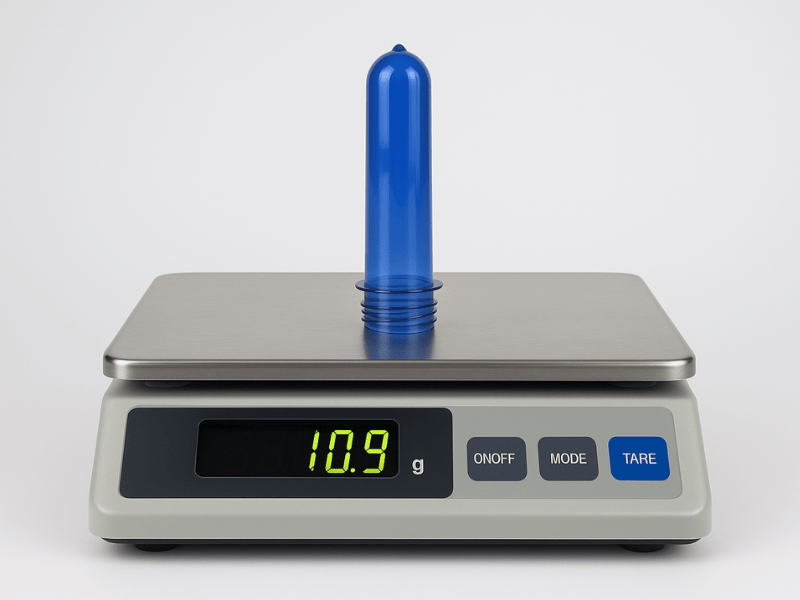
What Does PET Preform Weight Actually Mean?
Before comparing suppliers or bottle specifications, it’s crucial to understand what preform weight truly represents—it’s not just a number but the basis of cost, strength, and blowing stability.
In simple terms, PET preform weight refers to how many grams of resin are used to form one preform before blowing. This figure defines resin consumption and directly shapes bottle wall thickness and strength. Even a one-gram difference can change the total resin cost by thousands of dollars in a large-scale order.
For manufacturers like Enlightening Plast, preform weight determines melting behavior, stretch ratio, and cooling speed during injection and blow molding. A slightly heavier preform produces thicker walls and higher durability, but excess weight only wastes resin and slows production.
From a buyer’s view, weight selection links product design, cost, and performance. A 20 g preform suits a 500 ml carbonated drink bottle; an 18 g version works for still water. A mismatch can cause soft bases or cracked bottles during filling. Understanding the weight logic helps buyers match strength and efficiency before purchase.
How Is PET Preform Weight Determined?
Factors That Influence Preform Weight
Several design and process factors decide the final preform weight, and recognizing them helps you interpret supplier data instead of guessing.
- Bottle capacity and geometry: Larger or taller bottles need heavier preforms to maintain wall stability.
- Neck type and thread standard: A 28 mm PCO 1881 neck differs from a 38 mm wide-mouth; each requires distinct resin volume.
- Wall-thickness distribution: Engineers adjust wall thickness for balance between rigidity and stretchability.
- Material grade and intrinsic viscosity (IV): Higher IV resins have stronger chains and may allow lighter preforms without losing strength.
Typical Weight Ranges by Bottle Type
Industry practice groups weights within reasonable ranges rather than strict rules:
- 10–14 g for 350 ml water bottles.
- 18–21 g for 500 ml drinks.
- 24–28 g for 1 L containers.
- 45–55 g for 5 L oil or detergent bottles.
Each project still needs adjustment based on cap type, pressure requirements, and filling temperature.
Why Does PET Preform Weight Matter for Your Production Line?
Weight is not a minor parameter—it governs your total cost, bottle strength, and machine efficiency.
Impact on Cost and Resin Efficiency
Every additional gram increases resin use, which directly affects unit cost. Reducing weight by just 5 % on a one-million-piece order can save several tons of PET resin. Yet excessive lightweighting risks failures, so technical balance is essential.
Influence on Bottle Strength and Quality
An underweight preform stretches unevenly, producing thin walls and weaker bottles. Overweight preforms waste resin and may cause cooling stress or uneven clarity. The optimal weight secures mechanical strength while keeping material use minimal.
Effect on Blowing and Cooling Performance
During blow molding, preform weight determines heating energy and air-stretch ratio. Heavier preforms need higher heating temperature and longer cycles; lighter ones require precise temperature control to avoid deformation. Proper balance ensures smooth, energy-efficient production.
How to Choose the Right Preform Weight for Your Product
Choosing the correct weight starts with understanding your product’s filling and transport conditions.
For still water, lighter preforms (18 g for 500 ml) reduce cost and perform well under low pressure. Carbonated or hot-filled beverages demand heavier preforms, often 20 g or more, to withstand internal pressure or heat. Edible-oil bottles need thicker bases to resist deformation under continuous stacking.
Discuss your application with Enlightening Plast engineers; by sharing filling method, bottle shape, and budget, you can define the best weight range without sacrificing safety or appearance.
What Happens If the Weight Is Incorrect?
A wrong preform weight quickly translates into visible and financial losses.
Underweight preforms often cause bottle collapse, leaks, or tilted necks during blowing. Overweight designs raise resin cost and slow down mold cooling, cutting production output. Both lead to higher scrap rates and shipment delays.
If you’re already facing such issues, review our guide on pet preform defects to identify root causes before the next batch.
How Do Manufacturers Control and Test Preform Weight?
Weight-Tolerance Standards
Reliable factories maintain a ±1 % deviation from the designed weight. For a 20 g preform, this means only ±0.2 g difference is acceptable. Such precision keeps wall thickness consistent and ensures bottles fit automatic blowing equipment.
In-House Testing Practices
Manufacturers like Enlightening Plast use 0.01 g precision scales, wall-thickness gauges, and visual inspection under polarized light to check each lot. These daily controls prevent defects long before shipment. If you want to perform the same checks onsite, refer to our article how to check pet preform quality for step-by-step methods.
Can You Optimize Weight Without Compromising Quality?
Modern production focuses on lightweighting—reducing resin while maintaining performance. However, it demands engineering precision and experience.
Optimization involves adjusting wall distribution, neck crystallinity, and material IV. Enlightening Plast applies computer-aided mold analysis to reduce unnecessary thickness and test prototypes before mass production. This ensures stable blowing performance, clear transparency, and significant resin savings across large runs.
Recommended Reference Weights for Common Bottle Applications
| Bottle Size | Typical Neck Type | Standard Weight (g) | Typical Use |
| 350 ml | 28 mm PCO 1881 | 12–14 | Water, juice |
| 500 ml | 28 mm PCO 1881 | 18–21 | Water, soft drinks |
| 1 L | 30/25 short-neck | 24–27 | Juices, oils |
| 5 L | 48 mm wide-mouth | 45–55 | Edible oil, detergent |
These serve as practical benchmarks. Your ideal weight may vary slightly depending on filling pressure, resin type, and transport conditions.
How Preform Weight Connects to Sustainability Goals
Reducing weight is not only about saving resin—it also cuts your carbon footprint. Lightweight designs require less energy to melt, cool, and ship. When combined with recycled PET (rPET), they support circular-economy initiatives while keeping food-grade safety intact.
Enlightening Plast has developed lightweight preforms that maintain identical performance to heavier versions. By integrating rPET content and optimizing shape, we help brands meet sustainability goals without risking quality.
When to Ask Your Supplier for Custom Weight Design
If you plan to launch a new bottle line or change resin supplier, that’s the right time to request a custom weight review. Adjustments to weight are also recommended when switching from virgin PET to rPET, changing bottle shape, or adopting lightweight closures.
Our engineers at Enlightening Plast evaluate these factors through simulation and mold modification, ensuring that each preform meets both your mechanical needs and cost targets.
Partner with Enlightening Plast for Smarter Weight Solutions
Weight optimization is not guesswork—it’s an engineering balance of strength, clarity, and economy. A single gram can change everything from line efficiency to long-term sustainability. Working with Enlightening Plast, you gain a partner who understands that every bottle design must match your filling conditions, shelf-life goals, and market positioning.
We combine precise injection-molding control, ISO-certified quality systems, and decades of export experience to help you reduce unnecessary resin consumption while ensuring consistent strength. Whether you need standard weights or customized molds, we can calculate the most economical and durable solution for your bottles.
If you’re evaluating suppliers or planning a lightweight upgrade, contact Enlightening Plast today. Share your bottle type, filling temperature, and target budget—we’ll recommend the right preform weight and deliver a quote that saves cost without compromising reliability. Let’s build packaging that performs better, lasts longer, and supports your production goals with confidence.