
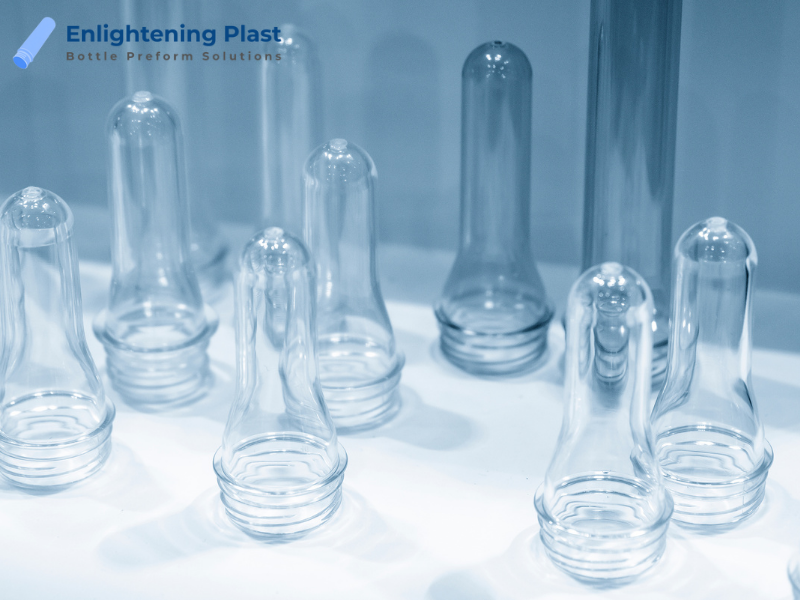
Picture this: You receive a shipment of crystal-clear PET preforms. Quality checks pass. Production starts smoothly. Then three months later, your warehouse manager sends you a photo—the remaining preforms in storage have turned yellow. Your supplier blames your storage conditions. Sound familiar?
Here’s what most buyers don’t know: while storage conditions can accelerate yellowing, it’s not that storage causes the problem—it’s that poor manufacturing makes preforms vulnerable to heat, humidity, and light. Through two decades of serving 50+ beverage brands, we’ve traced yellowing complaints back to their source and found that preforms with proper material quality and process control resist yellowing even under suboptimal storage.
This article breaks down the three hidden causes of preform yellowing that procurement managers need to understand before signing the next PO. We’re not here to sell you anything—we’re here to show you what questions your current supplier is hoping you never ask.
The 3 Hidden Reasons Your Plastic Preforms Turn Yellow
Most suppliers will tell you yellowing is caused by UV exposure, heat during shipping, or poor warehouse conditions. They’re not wrong—these factors do play a role. But what they won’t mention is that well-manufactured preforms can withstand these stresses without yellowing, while poorly made ones turn yellow even in controlled environments.
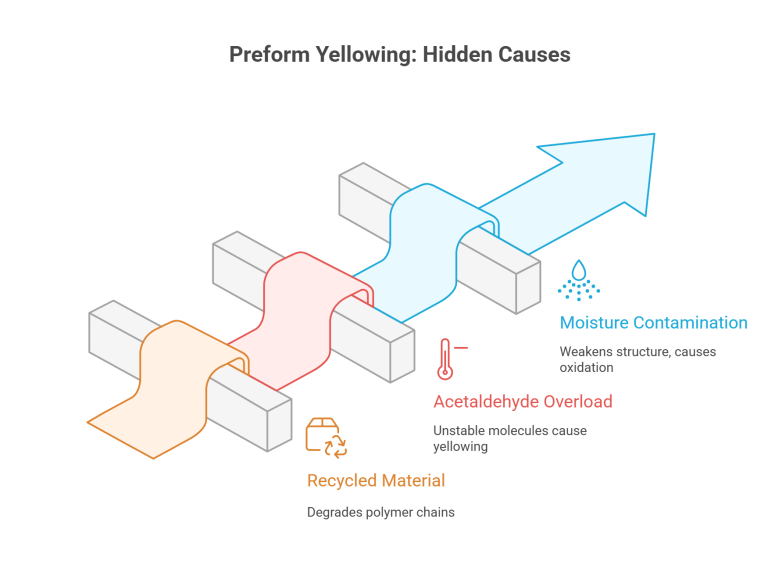
Reason 1: Recycled Material Contamination (The 15% Rule Most Ignore)
When a supplier tells you they use “virgin PET resin,” ask them to define “virgin.” Industry reality: many manufacturers blend 10-20% recycled PET (rPET) into the mix to cut costs by 8-12%. The problem? Recycled PET carries thermal history—it’s been melted at least once before, which degrades its molecular chains.
This degradation creates chromophores (color-forming molecules) that don’t show up immediately. Your preforms look clear at delivery because the yellowing is a time-delayed chemical reaction. After 8-12 weeks of normal storage at room temperature, those degraded polymer chains oxidize and turn yellow. By month six, the discoloration is visible to the naked eye.
The business impact? If you’re bottling premium mineral water, that yellow tint screams “low quality” to consumers—even if the water inside is perfectly safe. We’ve seen brands lose shelf placement in major retailers because of this issue.
Reason 2: Acetaldehyde (AA) Overload from Poor Temperature Control
Here’s a term you need to know: acetaldehyde (AA). It’s a byproduct that forms when PET is heated during injection molding. In small amounts (under 1 ppm), it’s harmless. But when barrel temperatures exceed 290°C—which happens when factories push machines too hard to increase output—AA levels spike to 5-10 ppm.
High AA content does two things: first, it gives your water a plastic taste (you’ve probably experienced this with cheap bottled water). Second, AA molecules are unstable. Over time, they react with oxygen and cause yellowing, especially in the preform’s neck finish where material is thickest.
The tell-tale sign? If your preforms yellow unevenly—with the neck area turning yellow faster than the body—you’re dealing with an AA problem. This happens because rushed production cycles don’t allow proper cooling time between injection cycles.
Reason 3: Oxidative Degradation from Moisture Contamination
PET resin is hygroscopic, meaning it absorbs moisture from the air like a sponge. Before injection molding, resin must be dried to below 0.005% moisture content (that’s 50 ppm). But drying equipment is expensive to run—it consumes significant electricity and adds 4-6 hours to production time.
Some manufacturers cut corners by under-drying resin to 0.02-0.03% moisture (200-300 ppm). What happens? During injection, that moisture turns into steam at 270°C, causing hydrolysis (water breaking down polymer chains). The result is a weakened molecular structure that oxidizes rapidly when exposed to air.
You won’t catch this with a visual inspection at delivery. The yellowing develops slowly as oxygen penetrates the preform walls over 60-90 days. By the time you notice, you’ve already used half the batch in production.
Yellowing is just one of several critical preform defects. Learn about other common issues like black spots, bubbles, and stress marks in our PET Preform Defects Guide.
How to Spot Yellowing Risk Before It Happens (Quality Check Checklist)
You can’t rely on suppliers to self-report quality issues. Here are four verification methods we recommend to procurement teams—these checks take less than 30 minutes but can save you months of headaches.
Demand the Resin Supplier Certificate
Ask your preform supplier: “Who manufactured the PET resin in this batch?” Legitimate manufacturers will provide a Certificate of Analysis (COA) from resin producers like Indorama, Reliance, or Jiangsu Sangfangxiang. This certificate lists the resin’s intrinsic viscosity (IV) value and confirms it’s virgin material.
If they hesitate or offer vague answers like “domestic resin” without specifics, that’s a red flag. Reputable factories maintain full traceability—they can tell you the resin batch number, production date, and IV value for every production lot.
Run the Hot Water Immersion Test
Take 5 preforms from random cartons. Submerge them in 70°C hot water for 2 hours, then air dry for 24 hours. Compare them to control samples kept at room temperature. If you see any yellowing or haziness develop in the tested preforms, it indicates poor thermal stability—likely from rPET contamination or high AA content.
This test simulates 3-6 months of aging in just 26 hours. It’s the fastest way to predict long-term color stability without waiting for real-time degradation.
For a complete quality inspection checklist beyond yellowing issues, read our guide on How to Check PET Preform Quality.
Check the Acetaldehyde Data Sheet
Any serious preform factory tests AA content for every production batch. Ask for the gas chromatography-mass spectrometry (GC-MS) report. The AA level should be below 1 ppm—preferably under 0.8 ppm for premium applications.
If they don’t test AA content, or can’t produce batch-specific reports, you’re dealing with a cost-focused supplier rather than a quality-focused manufacturer. GC-MS testing costs about $50 per batch, so refusing to do it signals they’re prioritizing margins over quality.
Inspect the Packaging Conditions
Open several cartons and check for condensation inside the plastic bags or cardboard. PET preforms should be packed in moisture-barrier bags with desiccant packs, stored on pallets (not directly on concrete floors), and kept away from direct sunlight.
If cartons show water stains, or preforms are packed loosely without moisture protection, the product has likely absorbed humidity during storage. Even if they look clear now, moisture absorption sets the stage for oxidative yellowing within 60 days.
Enlightening Plast Anti-Yellowing Process
We’ve spent two decades perfecting processes that prevent these exact issues. Here’s what we do differently, and why it matters to your bottom line.
100% Virgin PET with Batch Traceability
We exclusively use virgin PET resin from tier-one suppliers (Sinopec, Lotte Chemical, and ExxonMobil). Every production lot includes a QR code linking to the resin’s COA, production date, and IV test results. No blended materials. No “equivalent grade” substitutions. This adds 8-10% to our raw material cost, but it eliminates yellowing risk entirely.
The result? Our customers report less than 0.5% color deviation after 12 months of storage, compared to the industry average of 5-8% when rPET blends are used.
Precision Temperature Control (±2°C Variance)
Our injection molding machines maintain barrel temperatures at 275-280°C with ±2°C accuracy across all heating zones. Most factories allow ±5-8°C fluctuations to maximize throughput, which creates AA hotspots. We sacrifice 12% production speed to keep AA content below 0.7 ppm—verified by third-party GC-MS testing every 500 kg of output.
Lower AA means your preforms stay clear longer and your bottled water doesn’t develop that plastic aftertaste that drives consumers away.
Extended Resin Drying (6 Hours at 160°C)
We dry all PET resin for 6 hours at 160°C in dehumidifying hoppers, bringing moisture content to 0.002-0.003% (20-30 ppm). The industry standard is 4 hours at 150°C, which only achieves 0.005% moisture. That extra 2 hours costs us about $0.008 per kilogram in electricity, but it prevents hydrolytic degradation that causes yellowing.
Think of it this way: paying an extra $8 per 1,000 preforms now saves you from rejecting 5-8% of your inventory six months later—that’s a $150-200 loss per 1,000 units if you have to scrap yellowed stock.
Climate-Controlled Storage and Packaging
Before shipping, we store finished preforms in a 20-25°C warehouse with 40-50% humidity control. Each pallet is wrapped in aluminum-laminated moisture barrier bags with silica gel desiccant packs rated for 60 days of protection. This isn’t standard practice—most factories use basic PE film that allows 3-5% moisture transmission.
Our packaging costs an additional $0.15 per carton, but it ensures your preforms arrive in the same condition they left our facility, regardless of shipping time or climate variations.
The Real-Life Question: Can Your Current Supplier Pass These Tests?
We’re not asking you to switch suppliers based on one article. We’re asking you to verify what you’re currently buying.
Send this article to your supplier and ask them three questions: (1) Can you provide resin COA documents with batch numbers? (2) What’s your acetaldehyde testing protocol and frequency? (3) Will you guarantee zero yellowing for 12 months in writing?
If they answer all three confidently with documentation, congratulations—you have a quality-focused partner. If they deflect, blame storage conditions, or claim “yellowing is normal,” you now understand why.
Our Offer: Free Quality Comparison
We’ll give you 10 preforms at no cost—not as a sales pitch, but as a quality benchmark. Compare them side-by-side with your current supplier’s product using the hot water immersion test we described earlier. Run them on your blow molding line. Store them for 30 days and check for color shift.
Quality isn’t about who charges less per unit—it’s about who costs you less per usable unit after factoring in rejection rates, customer complaints, and brand damage. The cheapest preform that yellows after 90 days is infinitely more expensive than a premium preform that stays clear for 18 months.
Ready to verify what you’re really buying? Contact our team for the free comparison kit and third-party test reports that most suppliers won’t show you.