
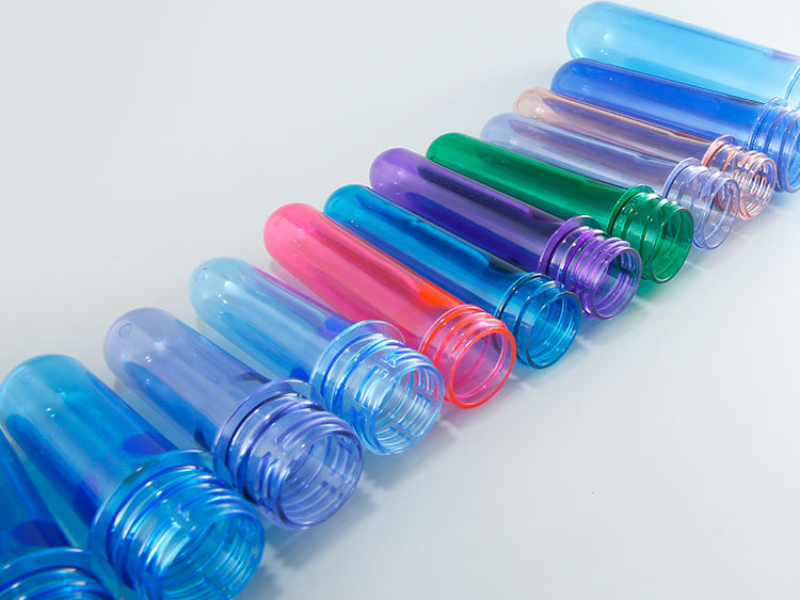
Every PET bottle starts with a preform, and its design decides far more than looks. Weight, wall thickness, and neck finish set the limits for strength, clarity, and sealing. A misfit design raises costs and slows your line; a precise one saves resin and keeps supply predictable. In this guide, you’ll see how to evaluate key design parameters, match them with your product’s real demands, and work with manufacturers to secure bottles that balance cost, efficiency, and shelf appeal.
What Does PET Preform Design Mean in Bottle Production?
Preform design is the blueprint that sets the key parameters of every bottle. It defines four essentials—weight, wall thickness, neck finish, and length—that decide how every bottle will behave once blow molded. If these figures are unclear, the result is often unstable bottles, wasted resin, or costly downtime on your filling line. So whenever you review a drawing, confirm these values first.
Each parameter plays a specific role:
- The weight sets both resin usage and bottle strength; a few grams too light means bottles crumple under stacking, while too heavy simply burns cash.
- Wall thickness must be balanced across the body, because uneven walls create tilted bottles and poor shelf appearance.
- The neck finish controls sealing with caps or pumps, and length sets the stretch ratio, which affects clarity and base stability.
Preform design directly affects your business results. A well-calculated design reduces resin waste, keeps bottles clear and stable, and prevents leakage on high-speed filling lines. When reviewing a supplier, ask how they control weight, wall thickness, neck finish, and length—this will tell you if they can protect your margins and ensure a steady supply.
How Do You Check the Key Design Parameters of a PET Preform?
Neck Finish Standards and Application Fit
The neck is the first place you should check, because it controls sealing.
- A 28 mm finish should keep its bore diameter at 22.5 ± 0.1 mm. If it’s outside this range, caps will either slip or jam.
- The end surface flatness should be within 0.05 mm; otherwise the cap gasket won’t seal, and leakage follows.
- Thread accuracy is easy to confirm: ask your supplier for a neck inspection report based on ISO standards.
If you are filling carbonated drinks, check whether reinforcement rings are added below the thread to resist pressure. For narrow-neck bottles, ask if the inside is polished smooth—rough surfaces make pumps or droppers leak. A good supplier should provide data and show actual neck samples for you to test with your closures.
Weight, Wall Thickness, and Stretch Ratio
Weight tells you both cost and strength. For a 500 ml water bottle, preforms are usually 28–32 g. Drop below 28 g and bottles collapse in stacking; go above 35 g and you waste resin. For sodas, you should expect 33–35 g, because CO₂ pressure needs thicker walls.
Wall thickness distribution is just as critical. The neck thread should be around 1.8–2.2 mm to hold caps under torque, while the base center should reach 2.5–3.0 mm to survive drop tests. If the base is thinner than 2 mm, breakage rates in transport rise sharply. You can ask suppliers for a wall thickness chart or request a few samples cut open for measurement.
Stretch ratio is harder to measure directly, but you can still check by asking: “What axial and radial ratios are you designing for this bottle?” The right range is 1:8–1:12 total stretch. If your supplier cannot answer, that means they are not simulating the blowing process properly.
Material and PET Grades
Material is the backbone of your bottle. PET grades are defined by their IV value (intrinsic viscosity), which measures molecular strength.
- 0.72–0.85 dl/g: Standard PET, fine for water and juices.
- 0.86–0.95 dl/g: High-IV PET, required for hot-fill teas and sodas.
- 0.70–0.80 dl/g rPET: Certified recycled PET, lowers cost but must meet FDA/EU food-contact rules.
If your bottles are sold outdoors, ask if a UV absorber (0.1–0.2%) is added; without it, bottles may yellow or crack in sunlight. For high-clarity bottles, confirm whether nucleating agents are used—and in what dosage—because too much makes bottles cloudy. Always demand the resin test report with IV values and compliance certificates. That’s the simplest way to know if the material really fits your product.
How Does Preform Design Vary by Application?
Carbonated Drinks and Pressure Resistance
For sodas and sparkling water, pressure is the biggest challenge. Bottles may reach 0.2–0.3 MPa internal pressure. If the preform design is weak, bottles will bulge or leak on the shelf.
In practice, you should confirm three things with your supplier:
- Preform weight around 33–35 g for 500 ml bottles.
- Base thickness no less than 2.8 mm.
- Neck reinforcement ribs under the thread.
Instead of just asking “is it strong enough?”, be precise: “At 0.25 MPa, can your preform survive stacking without bulging, and can you show me a pressure test report?”
Hot-Fill Juices and Heat Stability
Hot-fill lines run at 85–95°C, and poorly designed preforms shrink once the bottle cools. Here, you don’t need a long list—focus on material and base.
A reliable design usually uses IV 0.9 PET and a 3–4 mm concave base. The material grade stops deformation; the base shape absorbs shrinkage. You can also ask how long the preform is cooled in the mold—if it’s rushed, the bottle will lose stability later.
When discussing with your supplier, frame the request directly: “I need preforms for 90°C hot-fill tea. Use PET with IV around 0.9 and design a concave base at 3.5 mm. Can you guarantee shrinkage stays under 2% after cooling?”
Lightweight Mineral Water Bottles
In bottled water, every gram saved lowers cost, but unsafe lightweighting leads to collapse in storage. Here it helps to see the numbers side by side:
| Bottle Size | Target Weight | Side Wall (mm) | Base (mm) | Must Pass |
| 550 ml | 26–27 g | ≥0.8 | ≥2.5 | 1.5 m drop + 24 h stacking |
Don’t only weigh the preform. Ask your supplier for a wall-thickness distribution chart or a drop-test report. These prove the design balances low weight with real-world strength.
Household and Personal Care Bottles
This category is never standard—every closure and liquid changes the requirements. A detergent bottle needs chemical resistance, a shampoo bottle needs pump compatibility, and a dish soap bottle must flex when squeezed.
Instead of sending vague specs, tell your supplier:
- What closure you are using (pump, sprayer, or flip-top).
- What the liquid contains (surfactants, oils, or solvents).
- How you want the bottle to behave (rigid, squeezable, or both).
For example: “This is a 40 mm pump bottle for shampoo with surfactants. I need a neck bore of 40 ± 0.1 mm and PET blended with stabilizers. Can you share chemical resistance test data?” That way, you get a preform tuned for your product, not a generic compromise.
What Problems Arise from Poor Preform Design?
Poor preform design is easy to spot once you know where to look. If you can recognize the warning signs early, you avoid wasted money, rejected batches, and damaged brand image. Here are the main red flags.
Uneven wall thickness
Pick up a bottle and hold it against the light—if one side looks thinner, that’s a design flaw. These bottles tilt on shelves, collapse under stacking, or lose clarity. Inconsistent thickness also increases breakage during transport. Our preforms are designed with balanced stretch ratios, so wall distribution stays even every time.
Incorrect neck finish
The neck is where caps seal. If the bore or thread is off by just a fraction, caps will leak or jam filling lines. You can detect this by test-fitting closures—if torque feels uneven, the design is wrong. We polish and inspect every neck to ISO standards, which is why our customers rarely face capping stoppages.
Oversized or overweight preforms
Extra grams do not mean extra strength—they mean wasted resin and higher costs. For example, adding just 1 g per bottle at one million units equals an extra ton of PET resin every month. Buyers often realize this too late, when costs creep up. With precise CAD modeling, we keep preforms strong at the lightest safe weight.
Inconsistent design across batches
Perhaps the most frustrating problem is inconsistency. One batch fits your line, the next batch causes leaks. This usually comes from poor mold control or missing QC checks. It disrupts filling schedules and creates hidden losses. Our preforms are tested for weight, IV value, and dimensions every batch, ensuring you get the same results order after order.
These defects are easy to detect once you know where to look—and avoiding them is exactly how we design preforms for reliability and consistency. If you’d like a deeper dive into the most common issues, you can read our dedicated article: PET Preform Defects Guide.
How to Balance Design Appeal with Cost and Efficiency?
Shape, Color, and Labeling Area
Branding starts with the look of the bottle, but not every design detail is worth the cost. You can keep bottles attractive without overspending.
For shape, simple adjustments often work best. Instead of complex 3D embossing—which can push mold cost up by 30% and slow production—add two narrow vertical ribs (3–5 mm wide) on the body. They improve grip, add recognition, and cost almost nothing extra.
For color, avoid coatings that peel or add 0.1–0.2 RMB per bottle. Use transparent PET with 0.5–1% FDA-approved masterbatch. This gives a clean tint (blue, green, amber) and keeps costs at only 0.02–0.03 RMB per bottle.
For labeling, request a flat panel of 8–10 cm on the body. Uneven surfaces cause wrinkles and bubbles, raising reject rates from 1% to 3%. A smooth panel keeps labeling speed at 60 bottles per minute and improves shelf appeal.
Lightweighting and Material Savings
Every gram of PET counts. Cutting weight safely reduces cost without hurting quality.
| Application | Preform Weight | Savings Potential |
| 500 ml water | 26–27 g | Save 1 ton PET per month at 1M units |
| 500 ml soda | 33–35 g | Strong enough for CO₂ without waste |
The key is wall-thickness distribution. Keep 1.8–2 mm at the neck and 2.5–2.8 mm at the base for strength, while thinning the sidewalls to 0.8–0.9 mm. This trims 10–15% of resin but still passes drop and stacking tests.
When negotiating, ask: “What is the lightest weight you can design for my 500 ml bottle while still passing a 1.5 m drop test and 5-layer stacking? Can you provide the test report?”
Mold Cavities and Scalability
Molds decide both your upfront investment and your long-term efficiency. If you plan for scalability, you save money later.
- Cavity count: If you need 1M bottles a month, don’t stop at a 12-cavity mold. A 16-cavity mold costs about 20% more but covers future demand up to 1.5M bottles. This avoids buying a second mold later (which could cost $5,000+ and a week of downtime).
- Adjustable inserts: Ask for 5–7 mm height allowance in the cavity. If you ever upgrade from 500 ml to 550 ml, you just swap inserts instead of ordering a new mold.
- Ejection design: Request 3–4 ejector pins at the base instead of one. This shortens cycle time by 3–4 seconds per shot, boosting output by up to 30%, and leaves no visible marks on the bottle.
By clarifying these needs early, you keep production flexible and avoid hidden costs when your business scales.
Partner with a PET Preform Manufacturer Who Designs for Your Needs
Instead of leaving preform quality to chance, you’ve now seen how to spot design flaws, match specifications to your product, and request the right custom features from suppliers. These are the very factors that decide whether your bottles save resin, stay strong under pressure, and run smoothly on filling lines.
At Enlightening Plast, we build PET preforms with the parameters that matter most to you—whether it’s reinforced necks for carbonated drinks, high-IV resin for hot-fill juices, or lightweight designs that cut resin use without failing drop tests. Every order comes with test data and compliance reports, so you know exactly where your money goes and what risks you avoid.
If your concern is reducing unnecessary costs while keeping quality stable, talk to us. Share your filling process, capacity goals, or packaging standards, and we will deliver tailored designs, precise weight control, and scalable mold solutions. That way, you buy only what you need, protect your margins, and run your supply chain with confidence.